
Paver Painting: Recolouring Block Paving on the Costa del Sol
Paver painting gives faded concrete block paving one strong, even colour again without lifting a single block. We wash the paving and clear the joints, repair open joints and broken edges, cut in by brush and apply two coats of synthetic resin paint over drives, paths and patios.
Send us a photo and the m²Can block paving really be painted?
Yes, concrete block paving can be painted, as long as the blocks are firm and the surface is properly cleaned first. The coating covers the faces of the blocks and gives the whole area a single colour, which is the aim once the original reds and greys have bleached to pink and chalk.
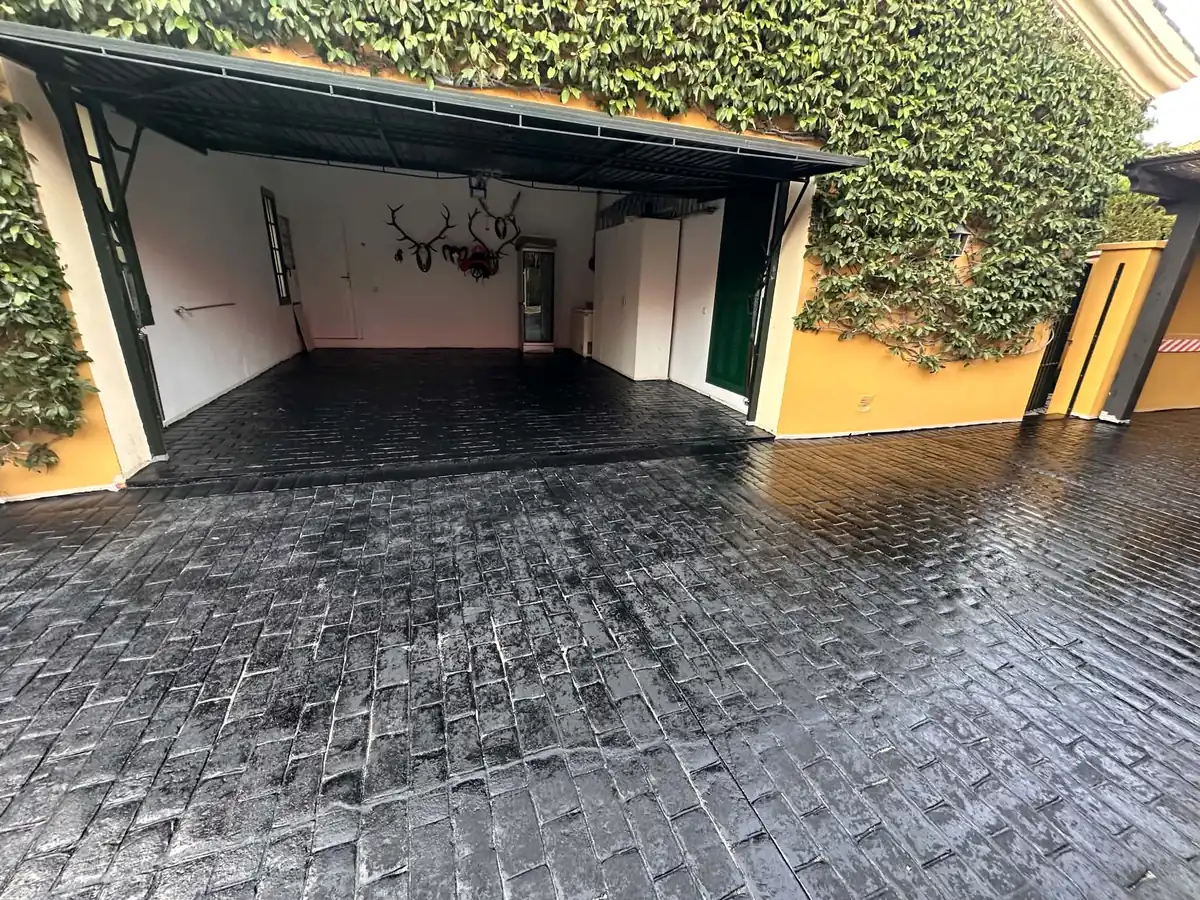
The photo shows the effect better than any description: the unpainted strip in front is the colour the whole area used to be, and behind it is the same paving after recolouring.
Why does block paving fade and look tired?
Block paving fades mainly because sun, rain and traffic wear away the colour at the surface of the blocks. Mixed-colour paving often fades unevenly, so a once deliberate pattern of reds and browns ends up looking like a random patchwork.
Weeds and moss in the joints, algae in shaded corners and tyre marks on the drive add to the effect. Cleaning alone brings back some of the original look, and our sister site on block paving cleaning covers that option; painting is the step to take when cleaning is no longer enough.
What happens to the joints when you paint pavers?
The joints are cleaned out during washing and repaired where they are open or have lost their filling. A firm, clean joint is essential, because paint over loose sand or a weedy gap will not hold and will look untidy within a short time.
The coating then covers the blocks and the joints between them in one colour. Done well, the blocks still read as individual pieces, because the pattern of their edges and bevels is kept, but the overall tone is uniform.
How is a block-paved drive recoloured, step by step?
The sequence is the same as for any surface we paint, but on pavers each stage has its own focus. This is a description of what we do on site, not a guide to doing it yourself.
- Washing: the blocks and joints are pressure washed to lift dirt, algae, moss and loose jointing material.
- Joints and edges: open joints are refilled, chipped block edges and broken kerb lines are repaired.
- Cutting in: the borders against walls, gates, drains and planters are painted by brush first.
- First coat: the colour goes over the blocks and joints to even out the faded base.
- Second coat: the final coat deepens the tone and gives the finished sheen.

Washing alone already makes a visible difference, as the photo shows. The colour coats then turn that clean but uneven paving into one consistent surface.
Which block-paved areas do we recolour?
- Block-paved driveways in front of gates and garages, where fading and tyre marks are most obvious.
- Paths and steps in pavers running from the gate to the front door or around the garden.
- Paved patios and courtyards, often laid in the same block as the drive.
- Parking areas for villas and small communities, where a fresh colour tidies the whole entrance.
If your drive is plain or imprinted concrete rather than blocks, see concrete painting; for paved terraces where you sit and eat, the patio and terrace painting page covers the extra points around furniture and pools.
How do you choose a colour for painted block paving?
A single solid tone, such as a mid or dark grey or a warm terracotta, works well because it calms a busy, faded pattern and looks modern. A contrasting border along the edge of a drive is possible where it can be cut in cleanly, and it can echo the kerbs or the gate.
Think about how the colour behaves day to day. Dark greys hide tyre marks and dust, warm reds suit traditional Andalusian houses, and light shades show every leaf and footprint. Our guide to painting block paving goes further into colour and pattern choices.
Is painting pavers better than cleaning or replacing them?
It depends on what you see after cleaning. If the blocks come up well with a wash, cleaning may be all you need; if the colour has gone, painting gives a much stronger result; and if the blocks are broken or sinking, replacement is the honest answer.
Painting sits in the middle: more transformative than cleaning, far less disruptive than lifting and relaying. Our article comparing the alternatives to painting your paving sets out each option side by side.
What affects the price of paver painting?
The square metres, the state of the joints, the number of edges and steps, and access all affect the price. Washing, joint and edge repairs and both coats are included in the standard job.
Our pricing site shows the indicative price per m², and a firm figure comes after we see your photos. It helps if you include a close-up of the joints and any blocks that look loose.
Frequently asked questions
Will the paint fill the joints between the pavers?
The coating covers the joints along with the blocks, but it is not a jointing material. Open or eroded joints are repaired before painting so the surface is firm and continuous. The aim is a uniform colour where the outline of each block is still visible.
Will weeds grow back through painted paving?
Weeds and moss are cleaned out of the joints before painting, and a well-repaired, coated joint gives them less room to establish. Seeds can still settle in any gap that opens over time, especially in damp, shaded corners. Keeping the surface swept and dealing with sprouts early helps a lot.
Can you paint pavers that have sunk in places?
Not successfully. Sunken or rocking blocks show a problem with the bed or base underneath, and paint will crack along them. Those areas need lifting and relaying first by a paving contractor, which is not a service we offer. Once the paving is level and firm, it can be recoloured.
Can you paint natural stone paving?
Our service covers concrete block paving, plain concrete and imprinted concrete. Natural stone slabs and setts behave differently and are often valued for their natural look, so we do not paint them. Cleaning may be the better route for stone, and our sister site on pressure washing covers that.
Can I keep a two-colour pattern?
Recreating a detailed multicolour pattern block by block is very labour-intensive and rarely gives a clean result. You can choose one solid colour, or add a contrasting border along the edges. Tell us what you have in mind and we will be honest about what will look good.
Is painted block paving slippery?
A coated surface is smoother than bare concrete blocks, and some finishes can feel different underfoot when wet. Slip resistance is given on the product data sheet (to be verified for each product), and we take slopes, steps and pool areas into account when choosing the finish.
Do you seal block paving instead of painting it?
Our system is a coloured synthetic resin paint applied in two coats, which also forms a protective film over the blocks. If you want to keep the exact original colour of the blocks with only a clear finish, that is a different product and not our standard service. Our sealing page explains the difference.
How long will painted pavers stay looking good?
That depends on the product, the traffic and the exposure, and the durability and recoating interval are given on the product data sheet. Regular gentle cleaning, avoiding harsh chemicals and fixing small damage early all help. Our maintenance guide explains the signs that recoating is due.
Can you paint the paving in a community entrance?
Yes, shared block-paved entrances and paths in urbanisations can be recoloured. The decision and budget usually go through the administrator and the owners' meeting. Send the photos and the approximate area, and we can provide a quote suitable for presenting to the community.
What photos should I send for a quote?
Send one wide shot of the whole paved area, a close-up of the joints, close-ups of any stains, cracked blocks or loose pieces, and a rough size in square metres. If there are steps, borders or walls along the edges, a photo of those helps us judge the brushwork involved.
Related articles
What Really Drives the Cost of Painting a Driveway in Spain
The cost of painting a driveway is driven far more by the condition of the surface and the shape of the area than by the paint itself. Square metres set the baseline; cra…

What Can Go Wrong When You Paint Outdoor Concrete, and How to Prevent It
The things that go wrong with painted concrete are predictable: old stains showing through, hairline cracks reappearing, tyre marks on a coating that was driven on too so…

Faded Block Paving: The Alternatives to Painting, Compared
For faded block paving there are five realistic routes: cleaning on its own, cleaning plus joint work, a clear sealer, recolouring with a coloured coating, or lifting and…

What It Is Like to Work With Us When You Live Abroad
Working with us from abroad comes down to three things: a clear quote based on your photos, an agreed plan for access and dates, and photo updates so you can see the work…

Is Painting Your Outdoor Concrete Right for You?
Painting outdoor concrete suits owners whose surfaces are sound but faded, who want a visible change without demolition, and who are happy for the colour to be renewed ev…

Preparing Outdoor Concrete Before Painting: What Happens and Why
Preparation is the part of a concrete painting job that decides whether the colour stays put, and it usually takes more effort than the painting itself. A properly prepar…