
Coloured Resin Coating for Concrete, Applied in Two Coats
A coloured resin coating for concrete is a film of synthetic resin paint that sits on the surface and gives it a new, uniform colour and sheen. We apply it in two coats over concrete that has been washed and repaired first, on driveways, carports, patios and paths across Málaga province.
Send us a photo and the m²What is a coloured resin coating for concrete?
It is a pigmented paint whose binder is a synthetic resin, rolled and brushed onto the concrete to form a continuous coloured film. That film is what you see and walk on: it carries the colour, sets the sheen and takes the everyday wear.
The concrete underneath stays as it is. Its pattern, texture and levels remain, which is why a resin colour coat is such a good fit for imprinted concrete whose design is still crisp but whose colour has gone.
Is this the same as a resin-bound driveway?
No, and the difference matters if you have seen resin driveways in the UK. A resin-bound or resin-bonded driveway is a new surface made of stone aggregate and resin laid over a base; ours is a paint coating applied to the concrete you already have.
We do not lay resin-bound or any other new surfacing. If you are after a new gravel-look finish, you need a surfacing contractor; if you want your existing drive to look fresh in a solid colour, a coloured resin driveway coating is exactly what we do.
Why apply the resin colour in two coats?
One coat rarely covers evenly on outdoor concrete. The surface absorbs unevenly, rollers leave thin patches and the texture of imprinted patterns creates hollows that a single pass skims over.
The first coat grips the prepared surface and evens out absorption. The second coat closes the gaps, deepens the tone and gives the consistent sheen people notice from the gate. That is why our standard two-coat resin colour coating is not an upgrade but the baseline.
The time left between coats, and before foot or vehicle traffic, is set by the product data sheet and the weather on the day; we do not shorten it to finish faster.
What can resin paint for outdoor concrete do, and what can it not?
Resin paint for outdoor concrete can restore colour, unify patched areas, bring back the definition of an imprinted pattern and give the surface a cleaner, easier-to-sweep finish. It can also act as a protective layer over the concrete against everyday dirt.
It cannot bridge a slab that is moving, stop damp rising from below or fill a sunken area. Nor can it turn a crumbling surface into a solid one; that needs repair first, which is why crack filling and edge repair are built into every job.
- Good fit: faded, sound concrete with fine cracks and tired colour.
- Needs repair first: chipped edges, small potholes, open joints.
- Not a fit: sinking slabs, active structural cracks, persistent damp.
How do we choose the product for your surface?
We choose the coating by reading its technical data sheet against the job: exterior use, the type of traffic, compatibility with the substrate and any existing coating, and the finish you want. We do not recommend paints by brand on this site, and we will not promise properties that the sheet does not state.
If you want to understand how paint families compare in general terms, our guide on outdoor floor paint systems sets out the differences, and our article on resin colour coatings versus clear sealers explains when each makes sense.
Where does a resin colour coating work best?
It works best on driveways, carports, patios and pool surrounds made of plain or imprinted concrete, and on concrete block paving that is still firm. These are the surfaces where colour loss is most visible and where a fresh, even tone makes the biggest difference to the house.
A resin colour coating for a concrete patio is particularly rewarding, because the patio is where you sit, eat and look out from; see our patio and terrace painting page for how we approach living areas. For the protective side of the coating, read about concrete sealing.
How much difference does a new colour make to the house?
More than you might expect. A bleached, patchy driveway makes even a well-kept villa look neglected, while the same ground in a deep, uniform tone frames the façade, the planting and the gate.
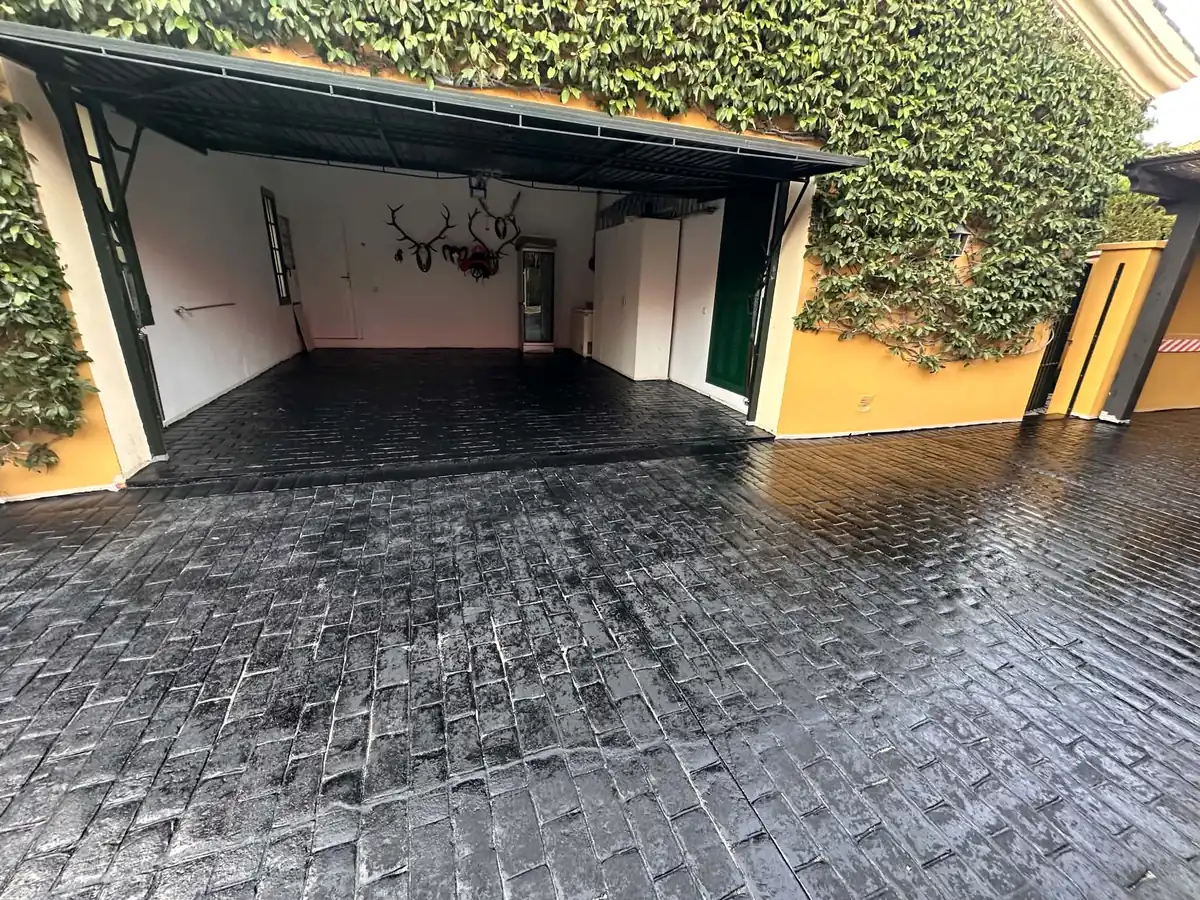
On the Marbella driveway on our projects page, the grey stone pattern had faded almost to chalk. After washing, crack filling and two coats, the drive and the carport read as one dark, glossy surface running all the way from the gate to the pergola.

If you are preparing a villa for sale or for the rental season, that first impression from the gate is worth thinking about. Our article on whether painting a driveway is worth it weighs it up honestly.
What does a resin coating cost?
The cost is driven by area, the amount of repair, access and the amount of edge work, rather than by the paint alone. Preparation and both coats are part of the standard price, so the quote you receive covers the whole job rather than just the paint, and the indicative rate per square metre is on our pricing site.
Frequently asked questions
What kind of resin do you use?
We use synthetic resin paint formulated for exterior floors, chosen job by job according to its technical data sheet. We do not name brands on this website because the right product depends on the surface, the traffic and the finish you want. We are happy to explain why a particular coating was chosen for your job.
Is a resin coating the same as epoxy flooring?
Not necessarily. Epoxy is one type of resin, widely used indoors and in industrial settings, but outdoor floor paints use a range of resin binders with different behaviour in sunlight and weather. We do not coat industrial or interior floors, and for exterior concrete we choose a product whose data sheet states it is suitable for outdoor use.
Can you apply resin colour over imprinted concrete?
Yes. Imprinted concrete is one of the best candidates, because the pattern stays visible while the colour returns. After washing and crack repair, the two coats bring back depth to the stone or cobble design. The Marbella driveway on our projects page is a good example of this.
Will the coating peel?
Peeling usually comes from poor preparation, damp coming through the slab, an incompatible old coating or applying in the wrong conditions. That is why we spend so much of the job on cleaning and repair and follow the data sheet for weather and timing. Our guide on why paint peels explains the causes in more detail.
How glossy will it be?
Sheen depends on the product. Some resin floor paints have a noticeable gloss that makes colours look richer, while others are more satin. We discuss the look you want, keeping in mind that a glossier finish may feel smoother underfoot when wet, and choose accordingly.
Do you lay resin-bound gravel driveways?
No. Resin-bound and resin-bonded surfaces are new surfacing systems laid with aggregate, and we do not lay new surfaces of any kind. Our service is recolouring existing concrete and block paving with two coats of synthetic resin paint after cleaning and repairs.
Can I have two colours, for example a border?
A contrasting border or band is possible where it can be cut in cleanly, for instance along the edge of a driveway or around a patio. It adds brushwork, which affects the quote. Tell us your idea with the photos and we will say whether it will look good on your surface.
Is resin paint safe around the pool?
Concrete pool surrounds can be coated, but the finish needs care because people walk there wet and barefoot. Slip resistance is stated on the product data sheet (to be verified for each product). We only use coatings whose sheet supports the intended use and discuss grip with you first.
What happens to leftover paint and wash water?
Paint residues must not go down drains. In Málaga city, for example, the sewer regulation prohibits discharging paints and pigments that cannot be removed by normal treatment. On our jobs, paint residues are not poured into drains or gullies, and rules in other towns should be checked locally (to be verified).
Can the coating be renewed later?
Yes, coated surfaces can generally be cleaned and recoated when the colour starts to tire, which is far simpler than starting from bare, damaged concrete. The recoating interval and compatibility are stated on the product data sheet. Our guide on looking after painted concrete covers the signs that it is time.
Related articles

Is Painting a Concrete Driveway Worth It?
Painting a concrete driveway is worth it when the slab is sound but the colour has gone, because it changes how the whole property looks for a fraction of the disruption …
Eight Mistakes Owners Make When Having a Patio Painted
Most disappointing painted patios come from a handful of avoidable decisions made before the work started: the wrong colour chosen from a tiny chip, a quote that skipped …

Coloured Resin Coating or Clear Sealer: Which Suits Your Surface?
Choose a clear sealer if you like the colour your concrete already has and only want to protect it or add sheen; choose a coloured resin coating if the colour has faded, …

Is Painting Your Outdoor Concrete Right for You?
Painting outdoor concrete suits owners whose surfaces are sound but faded, who want a visible change without demolition, and who are happy for the colour to be renewed ev…
Outdoor Concrete Floor Paint Systems: How They Differ
Outdoor concrete floor paints differ mainly in their binder, the resin that holds the pigment and sticks it to the slab, and that binder decides how the coating copes wit…
How to Choose the Colour and Finish for Painted Outdoor Concrete
The right colour for painted concrete is the one that links the floor to something permanent on the house, such as the roof tiles, the stone walls or the window frames, a…