How to Choose the Colour and Finish for Painted Outdoor Concrete
The right colour for painted concrete is the one that links the floor to something permanent on the house, such as the roof tiles, the stone walls or the window frames, and that copes with the dirt your surface actually gets. Sheen then decides how rich the colour looks and how the surface feels underfoot.
Send us a photo and the m²Where should you start when choosing a floor colour?
Start with what will not change. Stand at the gate and look at the roof, the walls, the shutters, the stone and the pool edge; the floor colour that picks up one of those will make the whole property look planned.
A common mistake is choosing from a small swatch indoors. Outdoor light on the Costa del Sol is strong and bright, and colours tend to look lighter and cooler on a large sunny surface than they do on a chart in the hand.
It also helps to photograph the house from the street and from the terrace, then hold colour options against those photos. Seeing the floor in the context of the whole building quickly rules out tones that clash.
Which colours work best on a Spanish villa?
There is no single best colour, but some combinations are reliably good. These are starting points rather than rules:
| House style | Floor colours that tend to suit | Why |
|---|---|---|
| White modern villa | Mid grey, anthracite, charcoal | Crisp contrast, hides tyre marks |
| Traditional Andalusian house | Terracotta, warm red, sandy beige | Echoes roof tiles and old clay floors |
| Natural stone walls | Warm grey, sand, stone tones | Picks up the colour of the stone |
| Small shaded courtyard | Lighter warm tones | Reflects light and opens the space |
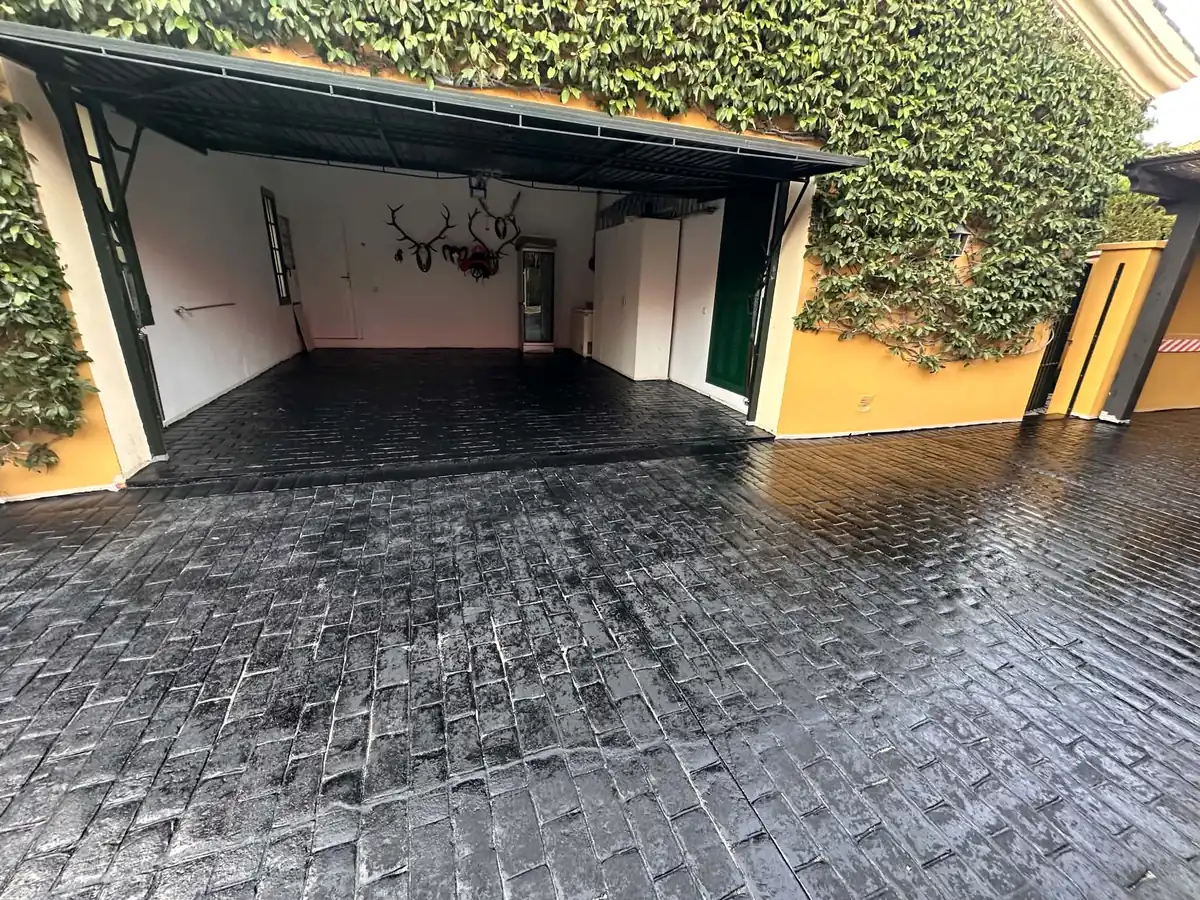
The Marbella driveway on our projects page went to a deep, dark tone, and the effect is a sharp, freshly finished look all the way to the carport.
How does colour affect how clean the surface looks?
Dark greys and charcoals are forgiving: they hide tyre marks, oil spots and general grime well, which is why they are a practical choice for driveways. On the other hand, pale dust, leaves and dried water marks show up more on very dark surfaces.
Light colours do the opposite. They show footprints, rust drips from furniture and tyre marks, but they hide dust better and keep a courtyard bright; mid tones are a sensible compromise for patio recolouring, especially on rental villas where the terrace needs to look tidy with minimal attention.
Does a darker floor get hotter underfoot?
In strong sun, darker surfaces generally absorb more heat and feel warmer to bare feet than lighter ones. On a driveway that rarely matters, but on a terrace or pool surround where people walk barefoot it is worth weighing up.
One approach is a darker drive and a lighter or warmer tone for the pool area and terrace, linked by colour family rather than identical shades. Our patio and terrace painting page explains how we approach living areas.
Gloss or satin: what difference does the sheen make?
Sheen changes the character of the same colour. A glossier finish deepens the tone, reflects light and makes the pattern of imprinted concrete stand out, while a satin or lower sheen looks softer and shows less glare in bright sun.
Gloss also tends to show scuffs and dust differently from satin, and a smooth, glossy finish can feel different underfoot when wet. The sheen of a coating is set by the product, so it is chosen together with the coating rather than added afterwards; see our page on coloured resin coating.
What about grip around pools and on slopes?
Grip comes first wherever people walk wet or on an incline. Around a pool, on steps and on steep driveways, the slip resistance of the finish matters more than whether it is grey or terracotta.
Slip ratings are stated on the product data sheet (to be verified for each product), and some systems offer textured finishes. Ask any contractor which rating the proposed finish carries and whether it suits the use; if they cannot tell you, keep asking.
Can you use more than one colour?
Yes, if it is done with restraint. A contrasting border along a driveway or a band around a patio can frame the space and echo kerbs or walls; the line has to be cut in cleanly, so it adds brushwork.
Detailed multicolour patterns, such as picking out individual stones on imprinted concrete, rarely look as good as owners hope and are hard to keep neat. One strong colour usually does more for a property than three competing ones. For plain driveways and paths, see concrete painting; for paving, see our guide to painting block paving.
How do you avoid regretting the colour choice?
Look at the colour outdoors, in the light of the area to be painted, and imagine it next to the walls and the planting. Think about what lands on your surface most often: dust from the hills, leaves, red soil, tyre marks.
Then think about time. A colour that is fashionable today may not suit the house in a few years, while one that echoes the architecture tends to stay right. Our article on mistakes to avoid when painting a patio covers colour regrets in more detail.
Frequently asked questions
What is the most popular colour for painted driveways?
We do not keep statistics, but greys from mid tone to charcoal are a practical option because they hide tyre marks and look clean against white villas. Terracottas and warm reds tend to suit traditional houses. The best choice is the one that suits your property, not the one other people pick.
Will the colour look the same as the chart?
Rarely exactly. Strong outdoor light, the texture of the concrete and the sheen of the finish all change how a colour reads. Looking at the colour outdoors in the area to be painted gives a far better idea than judging a small chip indoors.
Does a gloss finish fade faster?
Gloss level and colour retention are separate properties, and both depend on the product. The data sheet states the coating's resistance to ultraviolet light. Gloss finishes can show surface wear differently from satin ones, which is worth discussing when choosing.
Can I match the floor to my roof tiles?
You can usually get close by choosing the nearest shade from the product range. Roof tiles vary in tone and weather over time, so an exact match is unlikely, but a colour from the same family will tie the floor and roof together convincingly.
Are dark colours a bad idea around a pool?
Not necessarily, but they tend to feel warmer underfoot in strong sun, which matters where people walk barefoot. A lighter or warmer tone can work well around the pool. Whatever the colour, grip should be checked against the product data sheet before deciding.
Can I change the colour later?
A coated surface can generally be cleaned and recoated in a new colour, subject to compatibility on the data sheet. Going from dark to light usually needs more coverage than the reverse. It is still worth choosing carefully the first time to avoid the extra work.
Which colour hides dirt best on a patio?
Mid tones, such as warm greys and sandy shades, are the most forgiving overall because they hide both dark marks and pale dust reasonably well. Very dark and very light colours each show one type of dirt clearly. Think about what lands on your patio most often.
Should the driveway and patio be the same colour?
They do not have to be identical, but they should look related. Using one colour family, for example a darker grey on the drive and a lighter grey on the terrace, keeps the property coherent while suiting each area's use.
Does sheen affect slip resistance?
A smoother, glossier surface can feel different underfoot when wet than a satin or textured one. Slip resistance is a stated property of each coating, given on its data sheet (to be verified per product), so it should be checked directly rather than guessed from the sheen.
Can you recreate the original imprinted colours?
Original imprinted concrete often had a base colour and a darker release agent in the texture. Recreating that two-tone effect exactly with paint is difficult. One rich solid colour is usually the better choice, and it still brings the pattern back into focus.